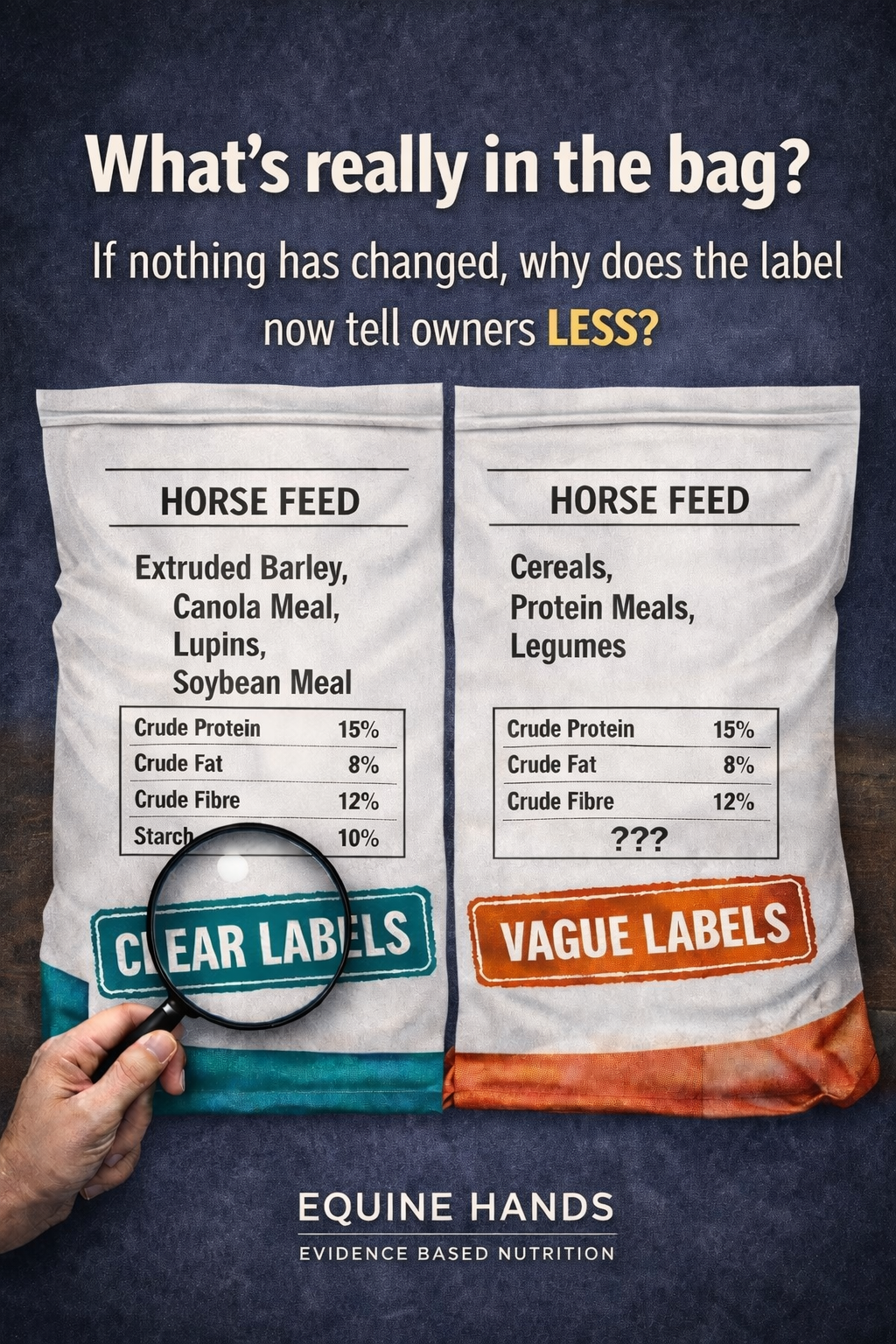
What’s really in the bag?
If nothing has changed, why does the label now tell owners less?
There has been renewed discussion lately about horse feed labels becoming more generalised.
Instead of seeing clearly named ingredients such as soybean meal, canola meal, extruded barley or lupins, owners may now see broader terms such as cereals, protein feeds, legumes or other catch-all ingredient categories.
That matters.
Because once a label shifts from specific ingredients to broad categories, owners lose useful information. And that makes it harder to properly assess what is actually in the feed, how suitable it may be for their horse, and how much confidence they can place in the product.
Why would a company do this?
The standard explanation is formulation protection.
Companies may say they operate in a competitive market and want to protect their formulations while still delivering a consistent product.
But if the formulation is genuinely fixed, the ingredients have not changed, and there is no least-cost substitution occurring, then an obvious question follows:
If nothing has changed, why does the label now tell owners less?
That is the problem.
Broader categories do not improve transparency. They reduce it.
Why this matters nutritionally
Horses do not eat nutrients in isolation - they eat ingredients.
Starch, sugars and NSC
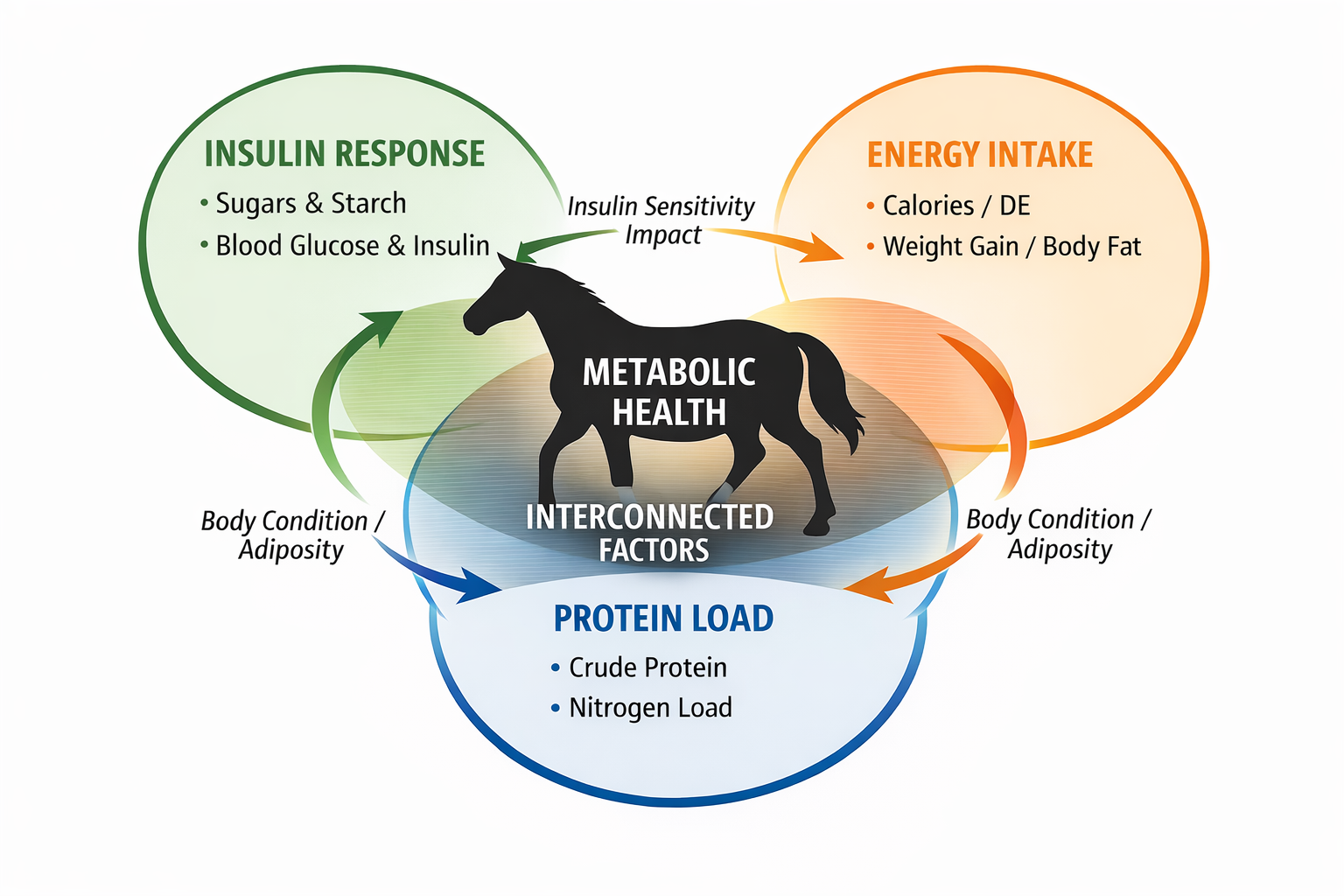
For metabolic horses, insulin-dysregulated horses, and those with a history of laminitis, one of the most important questions is the feed’s likely starch and sugar load.
If a label clearly declares starch and, ideally, simple sugars such as ESC, that gives owners useful information. But these values are often not listed, because they are not legally required.
When starch, ESC, or other useful carbohydrate values are missing, the ingredient list becomes much more important. It may be the only practical clue as to whether a feed is likely to be relatively high or low in non-structural carbohydrates (NSC).
So for horses where carbohydrate intake matters, vague terms such as cereals make it harder to judge whether a feed is truly appropriate.
Protein quality
Protein is a different issue.
Two feeds can show a similar crude protein % on the bag, yet differ markedly in quality depending on the ingredients used.
That is because protein sources vary in:
protein concentration
amino acid profile
how much of that protein is actually digested and absorbed by the horse
So a label that simply says 'protein meals' tells you very little about the real quality of the protein in the bag.
And that matters for growing horses, breeding horses, horses in work, and horses needing better muscle support or topline.
Because crude protein % is not the same as protein quality.
“It still meets the analysis” is not enough
This is where many owners get caught.
A company may say the feed still meets the nutritional analysis on the bag - and that may be true.
But horse owners and nutritionists need both:
a useful nutrient analysis
meaningful ingredient disclosure
These are not interchangeable.
A nutrient panel can help show values such as protein, fibre, fat, starch or sugars when they are declared. But the ingredient list helps us understand what is actually in the bag, where those nutrients are coming from, and how appropriate the feed may be for their horse.
Both pieces of information matter.
A feed may still meet the stated analysis, but vague ingredient labelling makes it harder for owners to properly assess what they are buying.
The real issue
This is not just about online drama or one feed company.
It is about transparency across the equine industry.
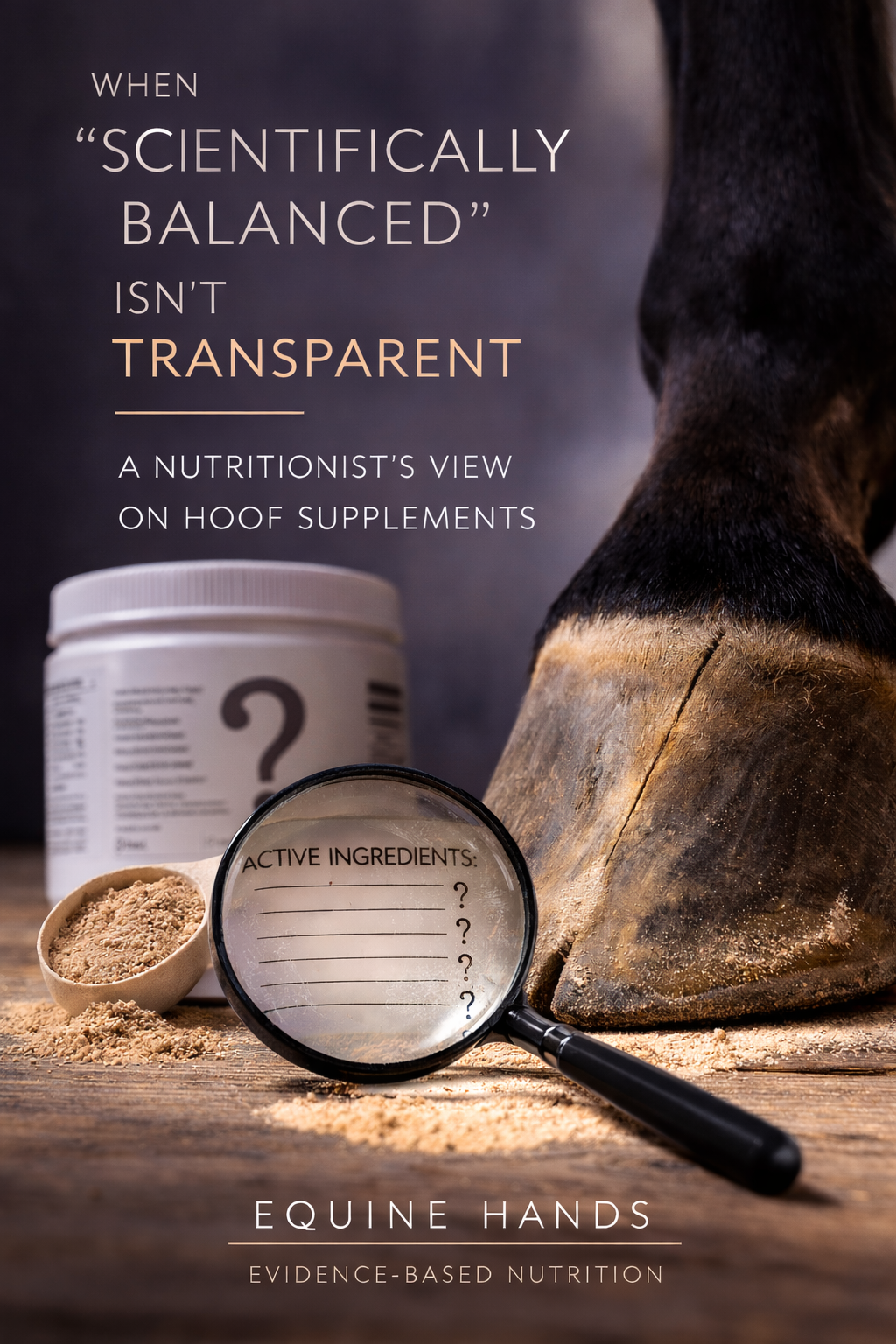
The same concern applies not only to bagged feeds, but also to supplements, where vague ingredient lists, proprietary blends, and incomplete disclosure can make it very difficult to properly assess what a product is actually providing. That has already been discussed in my previous blog on supplement transparency - because the principle is exactly the same: if owners are given less detail, they have less ability to make informed decisions.
That matters whether you are assessing a complete feed, a balancer, a gut supplement, a hoof supplement, or a joint product.
Horse owners are constantly told to “read the bag.” But that only works if the bag - or bucket, tub, or label - gives them meaningful information.
When labels become more vague, owners are being asked to trust more while being shown less.
Final thoughts
If a feed company says nothing has changed, the formulation is fixed, and ingredient quality remains the same, then reducing the level of detail on the label becomes very hard to justify from the customer’s point of view.
Because the issue is not whether the product still meets the numbers.
The issue is whether owners are still being given enough information to properly assess what they are buying.
And when it comes to horse nutrition - especially for metabolic horses, laminitis-prone horses, and horses with higher protein demands - that matters.