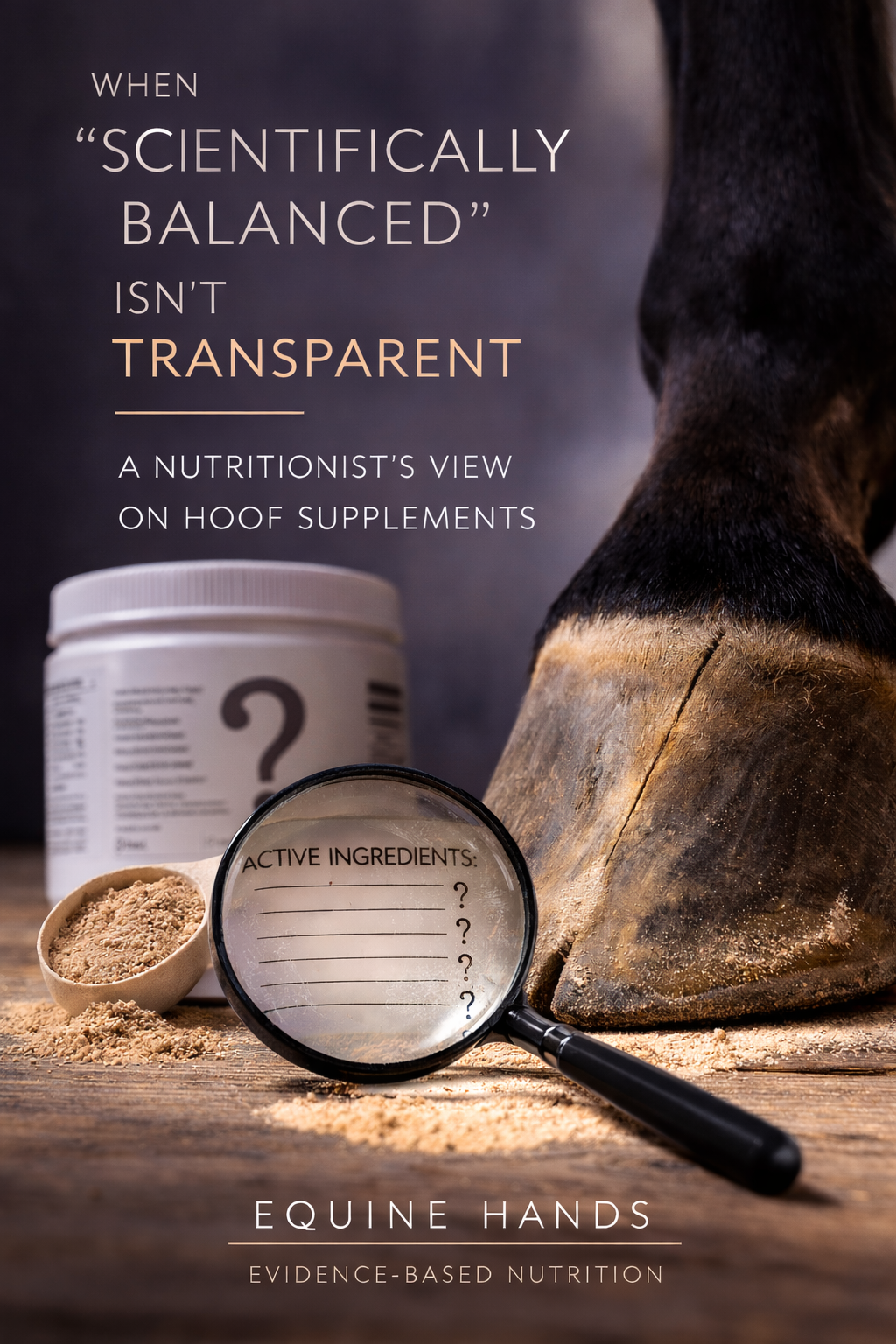
When “Scientifically Balanced” Isn’t Transparent - A Nutritionist’s View on Hoof Supplements
The equine supplement market is full of confident promises.
In the case of hoof supplement claims for stronger hooves, faster growth, healthier horn, scientifically balanced formulas are common.
I frequently review hoof supplements that contain biotin, methionine, MSM and zinc, often alongside what is described as a “scientifically balanced blend of essential vitamins, minerals and amino acids” or a proprietary blend.
On the surface, these formulations can appear comprehensive and well considered.
But this is where professional evaluation begins.
As an independent equine nutritionist, I am not aligned with any feed or supplement company.
My responsibility is to the horse in front of me.
And when ingredients are not transparent, I immediately dismiss the product.
Not emotionally. Not dramatically.
Simply professionally.
Because if I cannot see the numbers, I cannot assess the science.
Transparency Is Non-Negotiable
While we can never be 100% precise in a horse’s diet - particularly when pasture-based - the goal is always to measure and reduce uncertainty wherever possible.
The more we can quantify, the clearer the nutritional picture becomes and the more balanced and appropriate the diet is likely to be.
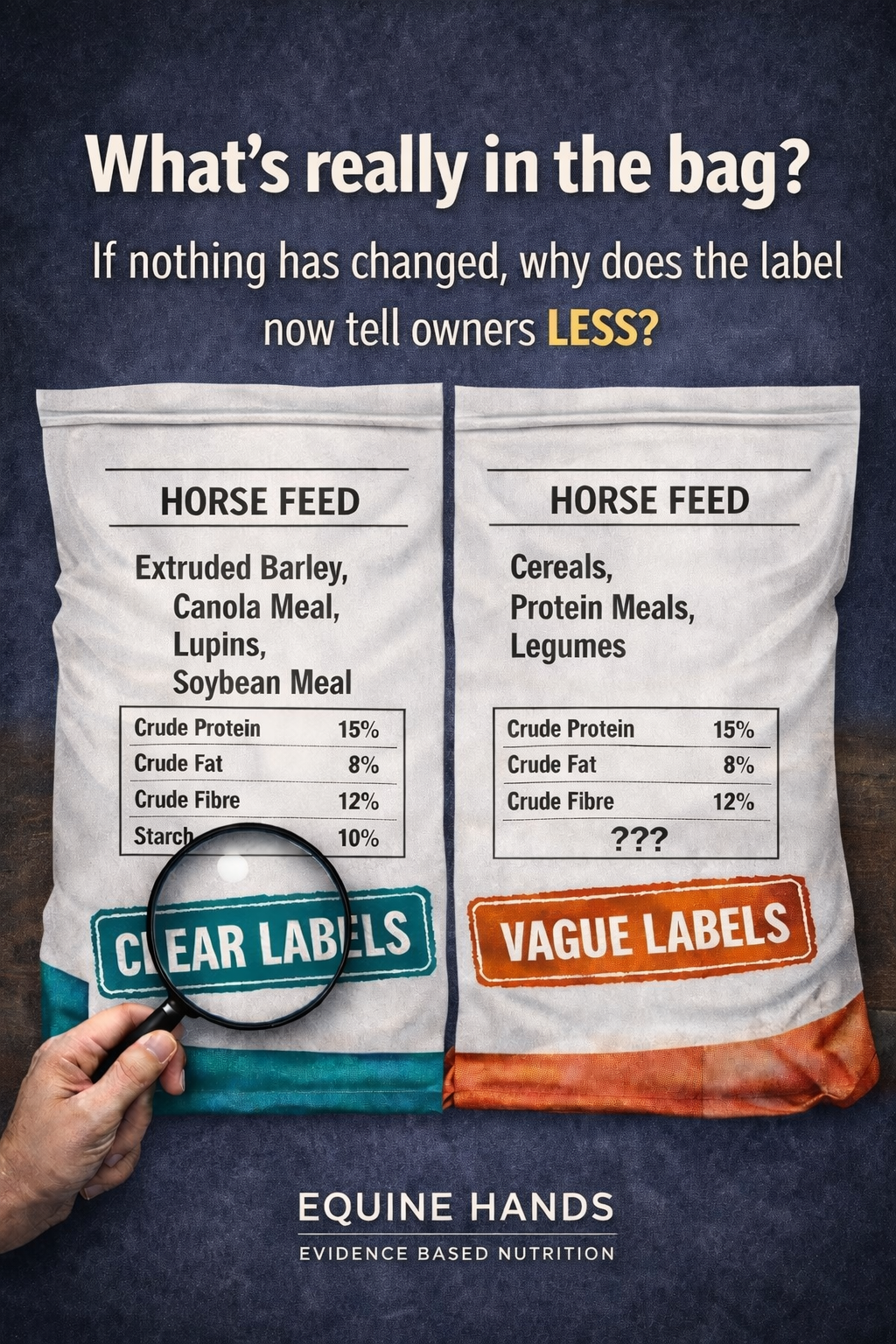
When a product includes a proprietary or “blended” formulation without disclosing exact nutrient inclusion rates, it becomes impossible to:
Calculate total daily intake
Evaluate safety margins
Assess trace mineral ratios
Determine whether the supplement corrects or creates imbalance
Without clearly stated levels of copper, manganese, selenium, iodine and other trace minerals, professional assessment cannot proceed.
The National Research Council (NRC, 2007) provides nutrient requirement guidelines based on bodyweight and physiological state. These standards allow diets to be evaluated against recognised benchmarks. If a supplement does not disclose its active levels, it cannot be properly assessed within that framework (NRC,2007).
“Scientifically balanced” is a reassuring phrase.
Numbers allow evidence-based evaluation.
Zinc doesn't act alone
Zinc plays a recognised role in keratinisation and epidermal integrity. It is involved in numerous enzymatic processes that support tissue health.
However, zinc does not function independently.
Copper is required for proper cross-linking of keratin fibres. Manganese contributes to connective tissue formation. Sulfur-containing amino acids form structural components of hoof horn.
Biotin functions as a coenzyme in fatty acid metabolism. Biotin supplementation has been shown to improve hoof horn quality in some horses when fed at therapeutic levels over extended periods (Comben et al., 1984; Kempson et al., 1987). Improvements were gradual and reflected the natural rate of hoof growth.
Importantly, trace mineral interactions must be considered. High zinc intake relative to copper may impair copper absorption due to mineral antagonism, particularly in diets already high in competing elements (Grace et al., 2010).
When zinc levels are disclosed but copper levels are not, formulation balance cannot be meaningfully evaluated.
Balance matters.
Bioavailability and Mineral Form
The form of a mineral can influence its absorption and utilisation.
Inorganic sources (such as oxides or sulfates) and organic or chelated forms differ in digestive behaviour. In some equine studies, organic trace mineral sources have demonstrated improved apparent absorption or retention compared to inorganic salts under certain dietary conditions (Wagner et al., 2005; Pagan et al., 2010).
However, it is important not to oversimplify this discussion or speak in absolutes.
In practice, both inorganic and organic mineral sources can be effective when used appropriately.
Many inorganic minerals are adequately absorbed when included at suitable levels within a balanced ration. For macro-minerals, forms such as magnesium oxide and calcium carbonate are widely used and often preferred due to stability, cost-effectiveness and reliable biological availability.
For trace minerals, chelated forms may offer advantages in diets where antagonistic interactions are significant, but inclusion rate and total dietary balance remain the primary determinants of efficacy (Wagner et al., 2005).
The key issue is not whether a mineral is organic or inorganic.
The key issue is whether the total diet is balanced and nutrients are supplied at levels aligned with recognised requirement guidelines.
Without disclosure of mineral forms, informed evaluation is limited.
Broad Feeding Rates Raise Questions
When a product recommends the same daily serving for horses across a very broad bodyweight range, precision becomes questionable.
Nutrient requirements scale with bodyweight and intake. This is why requirement standards are expressed on a mg/kg bodyweight basis.
A one-size-fits-most feeding rate may result in disproportionate intake across individuals.
In evidence-based nutrition, dosing should be deliberate, not arbitrary.
Manufacturing Claims vs Formulation Quality
Statements such as:
Produced in approved facilities
Made locally
Premium quality ingredients
Relate to production standards, not formulation balance.
Manufacturing consistency is important. It does not confirm that nutrient ratios are appropriate or that the formulation aligns with established requirement standards.
Production quality and formulation quality are not the same thing.
What Actually Influences Hoof Quality?
Hoof integrity is multifactorial.
Beyond biotin supplementation, factors influencing hoof quality include:
Zinc:copper balance in the total diet
Overall protein quality and sulfur amino acid availability
Iron load in forage systems
Endocrine and metabolic status
Mechanical loading and trimming practices
Environmental moisture variability
Biotin supplementation at therapeutic levels has demonstrated benefit in some horses over extended feeding periods (Comben et al., 1984; Kempson et al., 1987), but it does not override broader dietary imbalance.
In pasture systems where iron levels are elevated, trace mineral interactions may further complicate copper and zinc utilisation (Grace et al., 2010).
No supplement replaces foundational dietary assessment.
The Value of Independence
Being independent means I have no reason to defend a brand.
If a product is transparent, appropriately balanced and formulated, I will recommend it.
If ingredient levels are not fully disclosed, I will not.
This is not criticism. It is accountability.
Evidence-based practice requires full transparency.
If I cannot calculate it, I cannot justify it.
Final Thoughts
Hoof supplements are often marketed as solutions.
In reality, hoof quality reflects the cumulative effects of nutrition, mineral balance, management and time.
Marketing language cannot replace physiological understanding.
Hoof health develops over months. It is built on balanced nutrition, appropriate mineral ratios and consistent management.
And those foundations cannot be properly evaluated when key ingredients are hidden inside a proprietary blend.
Transparency allows nutrition to be assessed rather than guessed or assumed.
References
Comben, N., Clark, R.J., & Sutherland, D.J.B. (1984). Clinical observations on the effect of dietary supplementation with biotin on hoof horn quality in horses. Equine Veterinary Journal, 16(6), 579–582.
Grace, N.D., Knowles, S.O., & Nortjé, R. (2010). The effect of increasing iron intake on copper status in grazing livestock. Animal Production Science, 50, 104–112.
Kempson, S.A., et al. (1987). Influence of biotin supplementation on equine hoof horn growth and quality. Veterinary Record, 120, 209–212.
National Research Council (NRC). (2007). Nutrient Requirements of Horses. 6th Revised Edition. National Academies Press.
Pagan, J.D., et al. (2010). The effect of chelated trace minerals on mineral retention in exercising horses. Journal of Equine Veterinary Science, 30, 192–198.
Wagner, E.L., et al. (2005). The effect of copper, manganese and zinc source on mineral status in horses. Journal of Animal Science, 83, 203–212.