Lucerne, Insulin, Protein and Weight: Untangling the Confusion for Metabolic Horses
Lucerne (alfalfa) is one of the most debated forages when it comes to metabolic horses. Some professionals actively recommend it, while others advise avoiding it altogether. Horse owners are often left confused by conflicting advice, particularly when managing insulin dysregulation, equine metabolic syndrome (EMS), PPID (Cushing's disease) or laminitis recovery.
The reality is more nuanced.
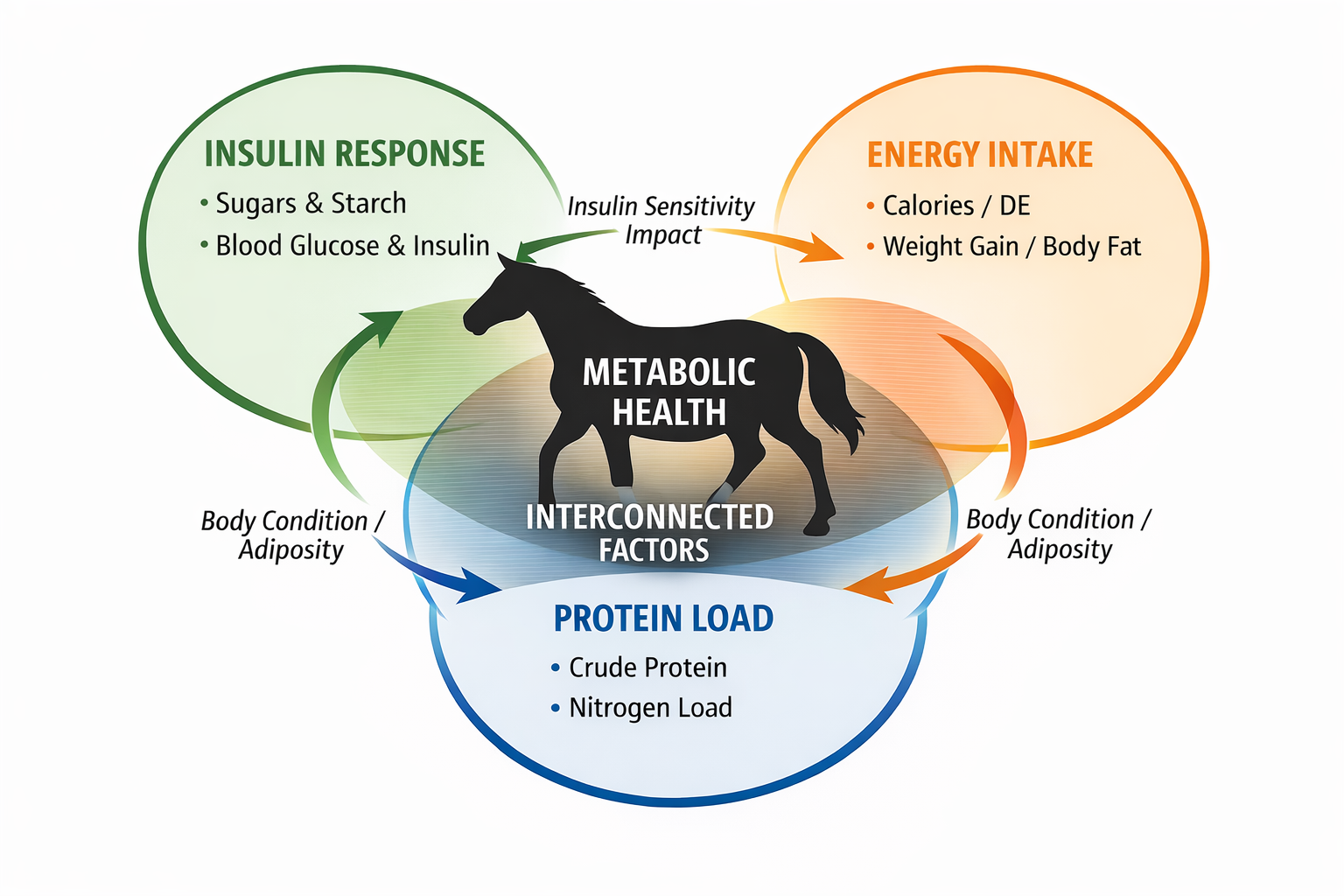
Understanding why requires separating insulin response, energy intake and protein load – three factors where insulin response to sugars and starch is well recognised, but the indirect effects of energy and protein load on metabolic stress and insulin sensitivity are often overlooked.
Lucerne and Insulin: Clearing Up the Sugar Myth
Lucerne is a legume, not a grass. This matters because legumes store carbohydrates differently.
Lucerne is typically low in ethanol-soluble carbohydrates (ESC; simple sugars) and starch and therefore does not cause post-feeding insulin spikes when appropriately selected. Australian laboratory datasets consistently show lucerne hay testing in the low to moderate range for non-structural carbohydrates, with water-soluble carbohydrates (WSC) commonly around 4–12% DM (dry matter) and starch generally low, often below 5% DM, though individual samples can fall outside these ranges.
WSC represents the sum of ESC and fructans; fructan content in lucerne is considered negligible. For metabolic horses, the commonly accepted target is a combined ESC + starch intake of approximately 10–12% DM.
As a general rule of thumb, lucerne cut at very early stages of maturity, grown under high irrigation, or harvested under drought stress tends to be more nutrient dense overall, regardless of cutting. While lucerne is typically low in sugar and starch, these conditions may increase total energy and protein load, which can be relevant for metabolically sensitive horses.
From an insulin standpoint alone, lucerne is generally considered a low-risk forage for horses with insulin dysregulation or insulin-associated laminitis. However, as with any forage, this is best confirmed through hay analysis, as individual samples can vary.
This is where much of the confusion begins:
While elevated insulin is the driver of metabolic disease in horses, insulin response is only one part of the picture. Low simple sugars and starch support insulin control, but they do not, on their own, determine whether lucerne is suitable for a given metabolic horse.
Energy Density: When Digestible Energy (DE) Becomes the Issue
Lucerne is more energy-dense than most grass hays.
When energy or “energy density” is discussed in relation to lucerne, it is often assumed that this refers to sugar. In lucerne, this is not the case as discussed above.
The majority of lucerne’s energy comes from digestible fibre and fermentable structural carbohydrates, which are broken down by microbes in the hindgut to produce volatile fatty acids (VFAs). These VFAs are a major energy source for the horse but do not produce the rapid glucose-driven rises in blood glucose and insulin.
This is the same principle by which feeds such as beet pulp can provide significant energy while remaining low in sugar and starch.
For metabolic horses, the issue is not that lucerne’s energy is “unsafe”, but that total calorie intake still matters. Even energy derived from fibre can contribute to weight gain or difficulty losing weight if intake exceeds requirements, and increased adiposity is a key driver of reduced insulin sensitivity.
In other words, lucerne’s energy is metabolically different from sugar, but it is not calorie-neutral.
Protein: Not Harmful, but Not Always Neutral
Lucerne is also relatively high in crude protein, often ranging from 18–22% or more.
Protein does not produce the rapid glucose-driven insulin spikes associated with simple sugars and starch. However, amino acids can stimulate a modest insulin response as part of normal metabolism to facilitate amino acid uptake into tissues. In horses, high-protein meals have been shown to increase post-prandial insulin concentrations, particularly in insulin-dysregulated animals. This response is physiologically different from the sharp glucose-mediated insulin spikes seen with high-sugar feeds, but it highlights that overall dietary load - not just sugar content contributes to the metabolic picture.
High-quality protein is valuable for:
muscle maintenance
topline support
older horses
those needing additional high-quality protein to support muscle and topline
However, in some metabolic horses:
total protein intake may already be adequate or excessive
additional protein increases nitrogen load and excretion demands
some horses appear less settled or less efficient on very high-protein rations
So while protein does not directly worsen insulin dysregulation, it still contributes to total dietary load and metabolic processing.
This is not about protein being “bad” – it’s about appropriateness for the individual horse and the rest of the diet.
When Lucerne Can Be a Good Choice
Lucerne may be helpful for metabolic horses that:
have insulin dysregulation but poor topline or muscle loss
are older or struggling to maintain condition
are on very low-energy grass hay and need added nutritional support
benefit from lucerne as a partial forage or ration component
In these cases, lucerne is often most effective when used strategically, rather than as the sole forage.
When Lucerne May Not Be Ideal
Lucerne may be less appropriate when:
weight loss is the primary goal
the horse is already overweight or obese
protein requirements are already met
lucerne displaces lower-energy forage in the diet
Again, this does not make lucerne unsafe – it simply means it may not align with the current management goal.
Considering the Inclusion Level
Another common source of confusion is how lucerne is substituted in the ration.
Lucerne is often introduced by replacing a grass hay on a weight-for-weight or volume-for-volume basis. Because lucerne is more energy-dense than most grass hays, this can inadvertently increase total calorie intake.
In many cases this is intentional with lucerne commonly added to support weight gain, topline, or muscle maintenance. However, when total energy intake exceeds the horse’s requirements, the horse will often “show it” through weight gain, difficulty losing condition or behavioural changes.
For this reason, a useful rule of thumb is that lucerne is often best fed as a reduced proportion of the total forage ration, rather than as a direct one-for-one replacement for grass hay.
The Takeaway
Lucerne is not “good” or “bad” for metabolic horses.
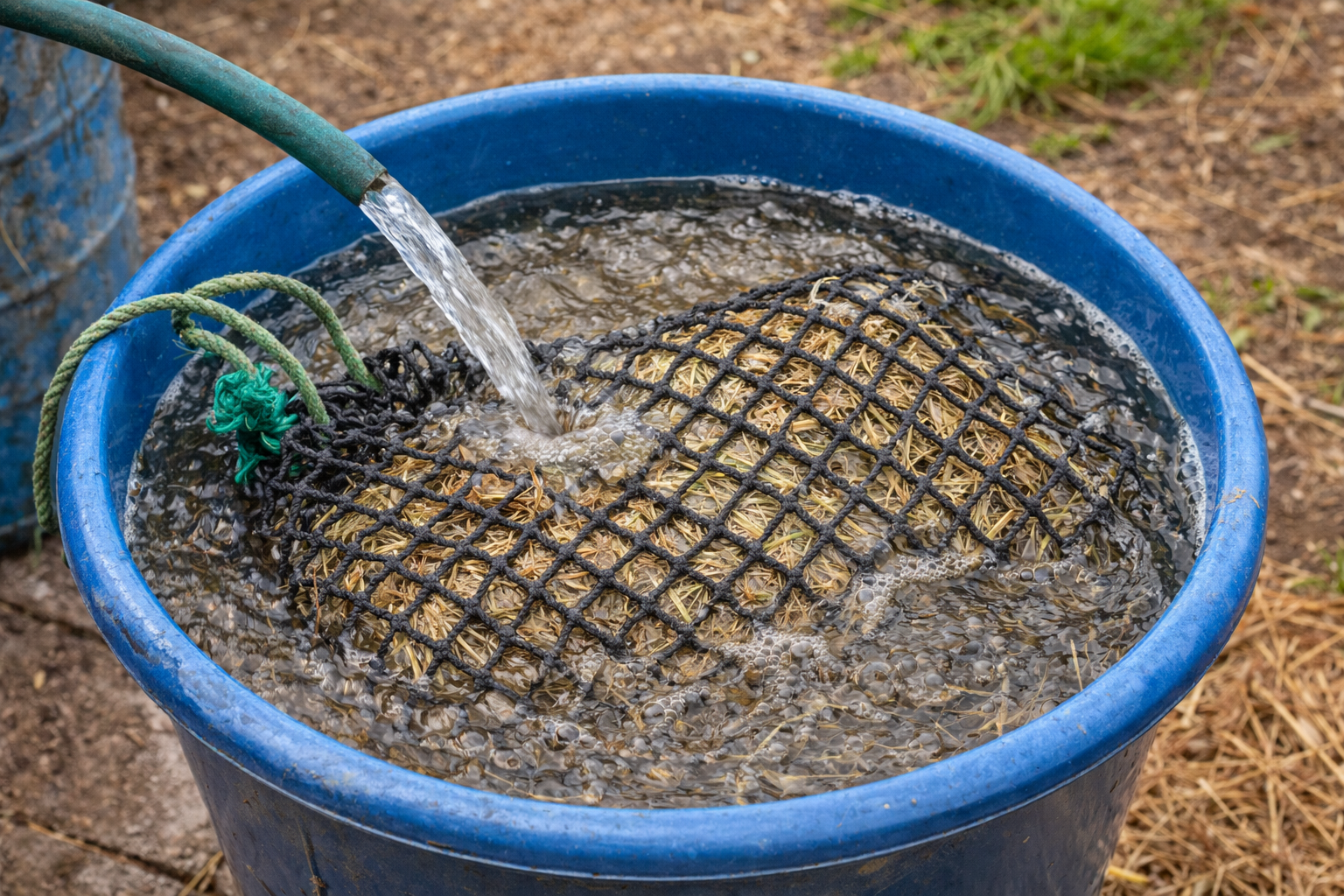
While lucerne is typically low in simple sugars and starch, occasional samples can test higher or be more nutrient dense overall, particularly when cut very early, grown under high irrigation or harvested under drought stress – reinforcing the value of forage analysis. Where testing isn’t feasible, visually assessing leafiness and maturity, moderating inclusion levels or using a short soak (around 15 minutes) as outlined in the previous post, can be practical risk-reduction strategies.
From an insulin perspective, lucerne is generally a low-risk forage when appropriately selected. However, it is also nutrient-dense, energy-rich and high in quality protein, which means suitability depends on the individual horse and the overall diet.
Lucerne can therefore be either helpful or counterproductive, depending on the horse, the rest of the diet and the current management goal.
As with all metabolic management, the answer lies in context, testing and individualisation, not blanket rules. Working with an equine nutritionist can help ensure lucerne is used appropriately within a balanced and individualised feeding plan.
Reference:
Loos, C. M. M., Dorsch, S. C., Elzinga, S. E., Brewster-Barnes, T., Vanzant, E. S., Adams, A. A., & Urschel, K. L. (2019). A high protein meal affects plasma insulin concentrations and amino acid metabolism in horses with equine metabolic syndrome. The Veterinary Journal, 251, 105341. https://doi.org/https://doi.org/10.1016/j.tvjl.2019.105341