Some horses shout. Some horses whisper. Some horses stop trying to speak at all
In horses, behaviour is often one of the first ways we notice that something may not be right.
Sometimes that behaviour is obvious - girthiness, ear pinning, nipping, reactivity, resistance under saddle, rushing, bucking or refusing.
But not every horse communicates discomfort loudly. Some become quieter. Some become guarded. Some simply keep compensating until the issue shows up elsewhere - in movement, muscle tension, performance, condition or behaviour that slowly changes over time.
Horses that shout
The horses who “shout” are often the ones labelled as difficult, dramatic, cranky or naughty.
They may react when brushed, resent being girthed, pin their ears, become tense under saddle, resist transitions, rush, buck, bite, or struggle to relax.
These behaviours can be frustrating for owners and they should always be managed safely, but they also should be used as valuable information. A horse that is reacting may be trying to tell us that something feels uncomfortable, confusing, stressful or physically difficult - and sometimes that can include subtle pain or low-grade injury that has not yet been clearly identified. .
Possible reasons include:
muscle and fascial tension
underlying soreness, low-grade injury or pain
saddle/girth or bit fit
hooves
teeth
gut discomfort
diet
pasture
workload
management
stress/environment
The behaviour is not the whole answer - but it can be the starting point for better questions.
Horses that whisper
Some horses do not protest loudly. They whisper.
Their signs may be easy to miss: a slight change in expression, reluctance to bend one way, less willingness to move forward, subtle girthiness, unevenness in transitions, reduced topline, changes in posture, inconsistent manure, altered appetite, dullness, or simply not feeling quite like themselves.
A whisper is still communication.
Horses that stop speaking
Then there are the horses who seem to stop asking.
These horses may be described as quiet, easy, tolerant, lazy or “good”, but sometimes what we are seeing is compensation or shutdown rather than comfort.
They may keep doing the job, but with tension. They may brace through the body, alter their movement, avoid using certain muscle groups, lose expression, become dull, or simply tolerate things that are not actually comfortable.
A quiet horse is not always a comfortable horse.
Why horses compensate
Horses are highly adaptable. When something is uncomfortable, they often find ways to work around it.
They may shift load, guard through the back, brace through the neck, alter stride length, avoid engaging the hind end, or carry tension through the fascia and soft tissues.
Over time, these compensations can become part of the horse’s normal way of moving. The original issue may not be obvious, but the body still shows the effects.
Nutrition and internal comfort
Discomfort is not always purely musculoskeletal.
Gut comfort, diet, forage, pasture changes, workload, metabolic status and management can also influence how a horse feels and behaves.
A horse that is reactive, girthy, dull, struggling to maintain condition, inconsistent in manure, or not building topline may need more than one area considered.
Looking at the whole horse
This is why I look at the whole horse.
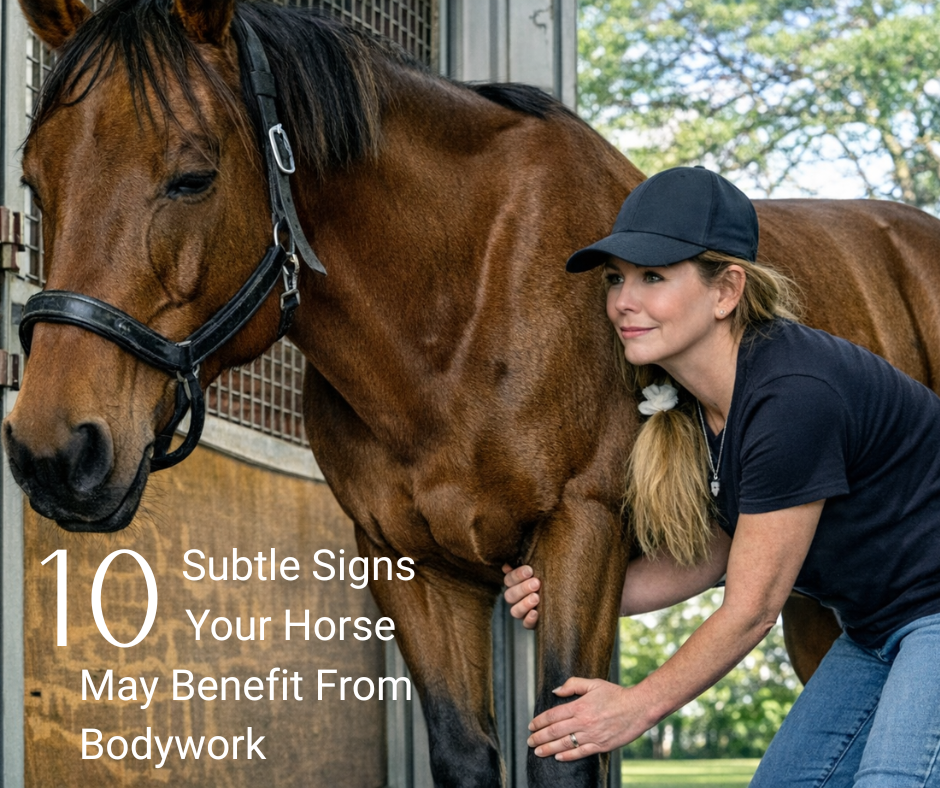
Bodywork can help identify areas of tension, restriction, guarding and compensation. Movement assessment can show how the horse is using their body. Nutrition evaluation can help identify whether diet, forage, pasture or management may be contributing to the bigger picture.
The goal is not to blame the horse, blame the owner, or assume there is one simple cause. The goal is to ask better questions and listen to the horse.
Giving the horse a voice
When we listen earlier, we often have more options.
The horse who shouts is not necessarily being difficult. The horse who whispers is not necessarily fine. And the horse who has stopped speaking may still have plenty to tell us, if we know how to look and listen.
Behaviour is communication.
Movement is communication.
Tension is communication.
Sometimes, it’s all connected.
If your horse is cranky, girthy, reactive, sensitive, tight, not building topline, struggling to hold condition, or simply not quite themselves, a whole-horse approach may help identify what could be contributing.
Equine Hands offers bodywork sessions and nutrition consults across the Central Coast and Hunter region, with remote nutrition consults available Australia-wide.